Achromatic Doublet Design Using a Custom Sequential Ray Tracer
From first-order chromatic correction to nonparaxial ray-tracing analysis
From first-order chromatic correction to nonparaxial ray-tracing analysis
The refractive index of materials is a function of wavelenght. Thus if incoming light is made of many wavelenghts, a single lens would not be able to focus it at the same spot. Thus the deisgn problem becomes - to maintain the focal length while reducing the chromatic aberrration.
Design Criteria:
Effective focal length | 75 mm |
Entrance pupil diameter | 7.5 mm |
F-number | f/10 |
Field | On-axis, 0° |
Object distance | Infinity |
Crown glass | N-BK7 |
Flint glass | F2 |
Design wavelengths | 486.1, 587.6, 656.3 nm |
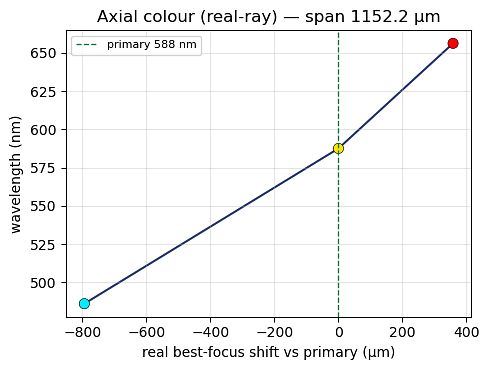
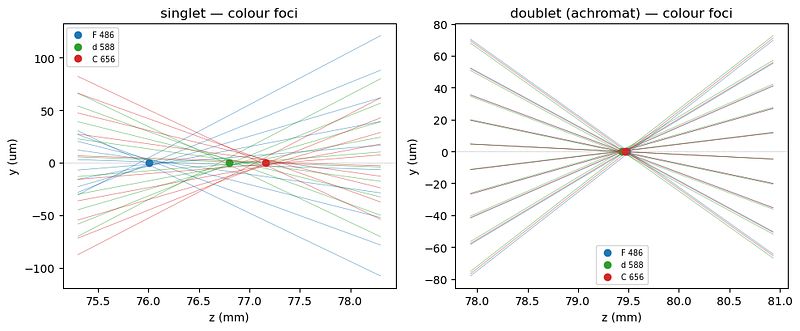
We start with a single lens of N-BK7 glass. This lens can match the focal lenght to our deisgn criteria but would give a chromatic focal shift as every wavelenght would be bent differently due to different refractive index. This is visible in the figure below. Red and blue wavelengths come to focus at ~1.1 mm away from each other.
Lets first tackle this in a first order way.
Achromat condition is :
\[ \frac{\Phi_1}{V_1} + \frac{\Phi_2}{V_2} = 0 \]
And thus the optical power of the first lens is :
\[ \Phi_1 = \frac{V_1}{V_1-V_2}\Phi \]
and the optical power of the second lens is :
\[ \Phi_2 = -\frac{V_2}{V_1-V_2}\Phi \]
We use the net power and the abbe number of the two lens materials to get their respective powers. Once we know the respenctive powers, we can start with some assumption of radii of surface 1 and predict every other radii using thin lens formula.
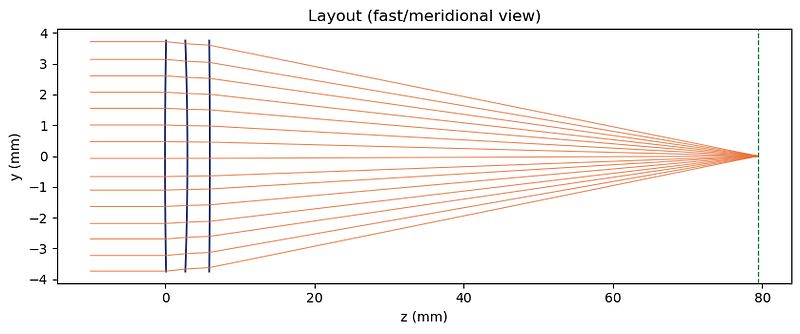
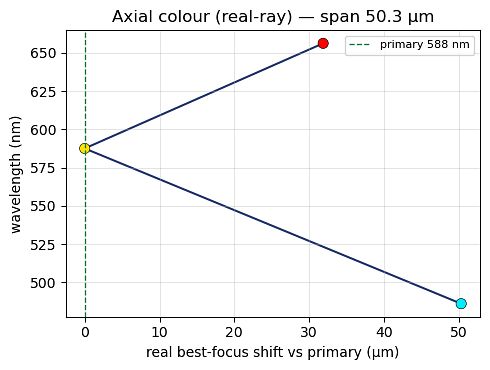
We now set up our doublet system, whose parameters have been calculated to fulfill achromat criteria at least wrt thin paraxial lens optics. We now run the ray tracer to see what happens to the axial spread of focii in this doublet case.
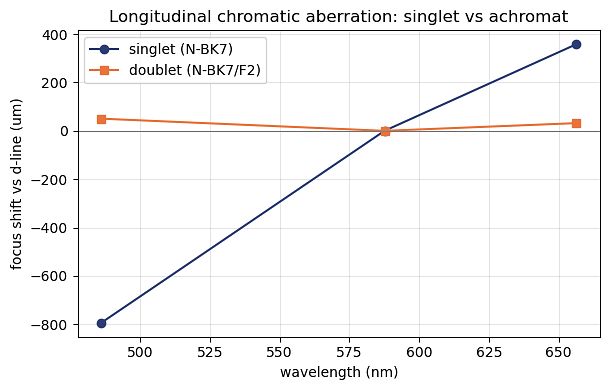
The longitudinal axis spread changes from 1152 µm to 50 µm. Note that for the former singlet case, the two extreme cases are the two extreme wavelenghts (red and blue). However, for the latter case, the two extremes in axial spread are not red and blue as is also visible in the figure below. The spread between red and blue is only 18 µm.
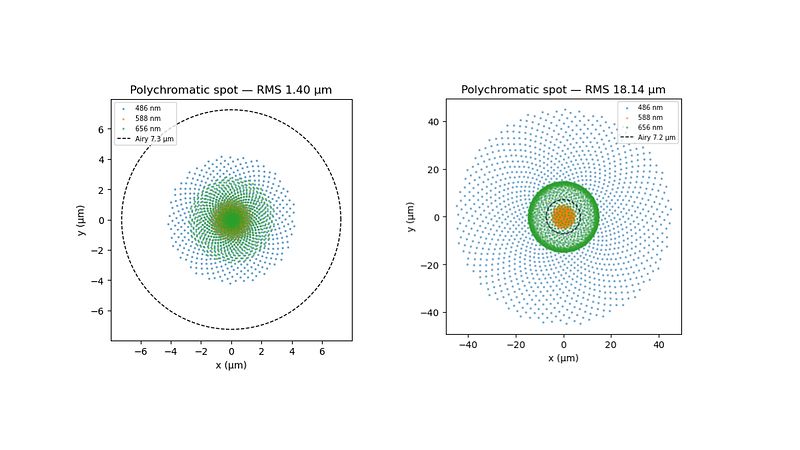
Let us also compare the rms spot size for these two cases at the best focus plane of the primary wavelenght. The figure below shows that adding more elements has reduced the weighted polychromatic spot size. Note that this does not mean that the primary wavelength spot size follows the same order. Also note that these designs are not yet optimized.
In conclusion, here using our in-house sequential ray tracer, I designe a cemented N-BK7/F2 achromatic doublet with a 75 mm effective focal length and an f/10 aperture.
The first-order design was derived from the achromatic power condition and Abbe numbers of the two glasses. Nonparaxial exact ray-tracing analysis demonstrated a substantial reduction in longitudinal chromatic aberration relative to an N-BK7 singlet with the same nominal focal length and aperture.
The doublet also decresead the polychromatic RMS spot radius from 18.14 µm to 1.42 µm, a reduction of approximately 92%.
This study demonstrates the application of analytical optical design principles, wavelength-dependent material properties, and numerical ray tracing to evaluate chromatic aberration correction in a multi-element lens.